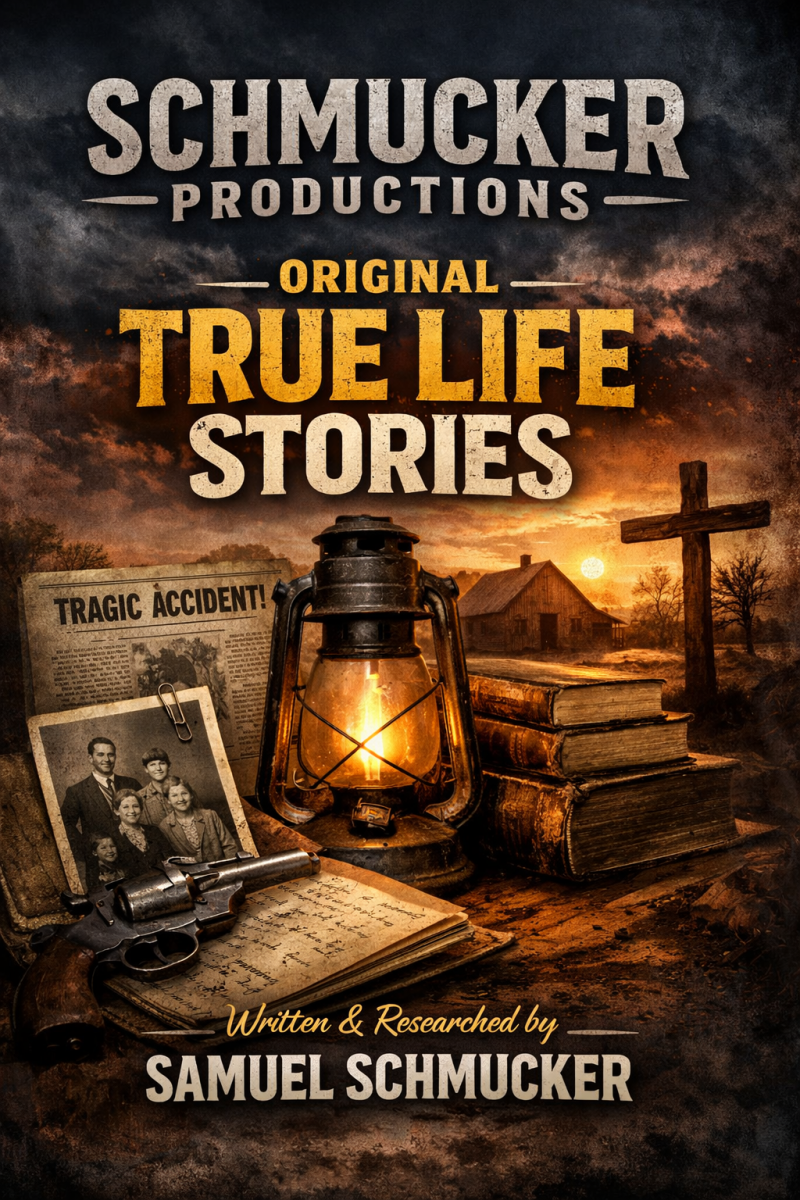
From the mind of Samuel Schmucker
Discover a world of captivating narratives rooted in truth. At Schmucker Productions, we craft original stories inspired by real people and genuine histories, presented through unique, cinematic lenses. Immerse yourself in tales meticulously researched and brought to life with passion and precision.
Unveiling forgotten histories
What makes our original stories special is their deep foundation in reality. We delve into historical archives, interview real individuals, and meticulously cross-reference facts to ensure authenticity. This commitment allows us to present narratives that are not just entertaining but also insightful, bridging the past with the present in a truly cinematic way. Each story is a journey, a careful reconstruction of events designed to resonate deeply with audiences who value truth and depth.

Stories that spark reflection
These stories are for anyone who craves narratives beyond the superficial – for history buffs, curious minds, and those who appreciate the art of storytelling. We imagine our audience as individuals who enjoy peeling back the layers of time to understand the human experience in its rawest form. Our message is simple: history is not just a collection of dates, but a vibrant tapestry of lives, struggles, and triumphs waiting to be rediscovered. We hope to inspire wonder, provoke thought, and foster a deeper connection to our collective past.

Experience the past, reimagined
Schmucker Productions is dedicated to crafting narratives that not only inform but also transport. From untold personal sagas to sweeping historical events, our original stories are designed to bring the past vividly to life. Join us on a captivating journey where every story is a window into a true experience, carefully researched and cinematically presented for your enjoyment. Explore the power of authentic storytelling.
Story 1
Marilyn Monroe
MARILYN: THE GIRL WHO NEVER STOPPED SHINING
By Samuel L. Schmucker — Schmucker Productions
Page 1: The Birth of Norma Jeane
Before the world knew her as Marilyn Monroe, she was simply Norma Jeane Mortenson — born June 1, 1926, in Los Angeles, California. Her mother, Gladys Pearl Baker, worked as a film cutter for RKO Pictures, and her father’s identity remains uncertain, though some records list Edward Mortenson, and others point toward Charles Stanley Gifford, a man Gladys once loved.
Norma Jeane’s childhood was marked by instability. Gladys struggled with mental illness, spending long stretches in institutions, and Norma Jeane was placed in a series of foster homes and an orphanage. Her sense of belonging — of being loved and wanted — became the one thing she would spend her life chasing.
“I used to think as a child that no one ever loved me,” Marilyn once said. “And I would think how nice it would be to be loved by someone.”
That longing would later fuel the light behind the camera — the glow that became impossible to ignore.
Page 2: From Norma Jeane to Marilyn Monroe
Her first escape from a broken home came through marriage. In 1942, at just sixteen, she wed James Dougherty, a neighbor five years older. He was steady, kind — but when he joined the Merchant Marines, she began working in a munitions factory. That’s where fate intervened.
A photographer for the Yank military magazine snapped her picture on the assembly line, and soon Norma Jeane found herself posing for pin-up photos. The camera adored her — and for the first time, she adored herself in return.
By 1946, she had signed a contract with Twentieth Century Fox. Studio executive Ben Lyon suggested a new name: “Marilyn” after the Broadway star Marilyn Miller, and “Monroe,” her mother’s maiden name. And just like that, Marilyn Monroe was born — though the name felt like a costume she’d wear forever.
Her early modeling work appeared in Modern Screen, Photoplay, and later, Playboy, which famously published her 1949 nude calendar photos in its 1953 debut issue — catapulting her into global fame.
Page 3: Stardom and Silver Screens
Between 1947 and 1962, Marilyn made over 30 films — a stunning range from comedies to dramas that showcased her depth beneath the blonde stereotype.
Niagara (1953) revealed her as a sensual force of nature.
Gentlemen Prefer Blondes (1953) made her a cultural phenomenon, performing “Diamonds Are a Girl’s Best Friend” — an anthem of glamour and survival.
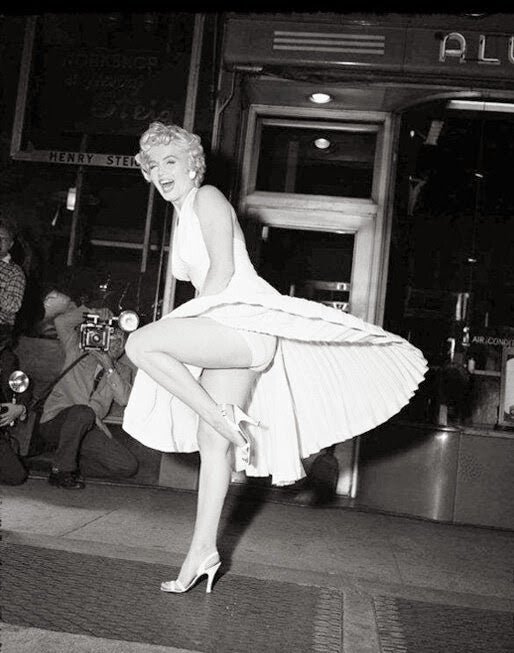
The Seven Year Itch (1955) immortalized her white dress blowing over the subway grate, an image that defined an era.
Bus Stop (1956) and Some Like It Hot (1959) proved her acting skill rivaled her beauty.
In the background, Marilyn fought the system — demanding respect as more than a pin-up. She founded Marilyn Monroe Productions, one of the first female-led production companies in Hollywood. Behind her smile was a woman fiercely determined to control her destiny.
Page 4: The Men and the Myths
Marilyn’s love life fascinated the world.
Her first husband, James Dougherty, loved her as Norma Jeane — but not as Marilyn. They divorced in 1946.
Her second husband, baseball legend Joe DiMaggio, married her in 1954. Their union of beauty and brawn captivated the public — but his jealousy and her fame made peace impossible. They divorced after nine months, though he would remain devoted to her until his death, even arranging roses to be placed at her grave three times a week.
Her third husband, playwright Arthur Miller, offered intellectual refuge. They married in 1956, but Hollywood pressures, miscarriages, and emotional distance shattered the marriage by 1961.
Each man, in his own way, loved the woman the world saw — not always the woman she was.
“Hollywood is a place where they'll pay you a thousand dollars for a kiss and fifty cents for your soul,” Marilyn once reflected.
Page 5: The Fall and the Darkness
By 1962, Marilyn’s career seemed to shimmer again. She was filming Something’s Got to Give and mending bridges with studios. But privately, her life was crumbling.
She battled insomnia, depression, and dependency on barbiturates. Rumors of relationships with President John F. Kennedy and his brother Robert Kennedy filled tabloids. Friends said she was lonely — not scandalous, but broken.
On August 4, 1962, Marilyn Monroe was found dead at her Brentwood home. The coroner ruled it a probable suicide by overdose. She was 36.
The tragedy rippled through the world — Hollywood had lost its brightest light. Conspiracy theories would swirl for decades, from political cover-ups to accidental overdose, but the truth was simpler and sadder: Marilyn died of loneliness and exhaustion — a soul crushed by fame.
Page 6: The Legacy That Lingers
Marilyn was laid to rest at Westwood Village Memorial Park Cemetery in Los Angeles, in a crypt that remains covered in lipstick kisses to this day. Her half-sister, Berniece Miracle, survived her, as did a few cousins and extended relatives. Berniece wrote a loving memoir, My Sister Marilyn, honoring the fragile woman behind the legend.
Even now, her image sells perfume, posters, and dreams. But for every glamorous pose, there’s a shadow — a woman who wanted nothing more than to be taken seriously, to be loved, to be seen.
“She lived like light — fragile, blinding, and impossible to hold,” writes Samuel L. Schmucker of Schmucker Productions. “And though the candle burned out far too soon, its glow never died.”
Sources and Quotes:
Marilyn Monroe quotes from: Marilyn Monroe: In Her Own Words (Random House, 1983).
Joe DiMaggio accounts from Dinner with DiMaggio by Dr. Rock Positano (Simon & Schuster, 2017).
Biographical data verified through public domain historical records and The Marilyn Encyclopedia by Adam Victor (Overlook Press, 1999).
All narrative and descriptive text written originally by Samuel L. Schmucker, © 2025 Schmucker Productions.
Story 2
John Dillinger
John Dillinger: America’s First Celebrity Outlaw
By Samuel L. Schmucker
Feature Article | True Crime & History
“I went in a petty thief and came out a professional.”
— John Dillinger, 1933
The Birth of a Rebel
Long before the headlines, the manhunt, and the gunfire in a Chicago alley, John Herbert Dillinger was just a restless boy from Indianapolis, Indiana, chasing trouble more than purpose.
Born on June 22, 1903, he was a mischievous son of a grocer — bright, impulsive, and allergic to authority. His mother’s death when he was just four years old left a hole that no rule or religion could fill.
His father, a strict man who believed in hard lessons, moved the family to Mooresville, Indiana, hoping country life would settle his son’s wild streak. It didn’t.
Dillinger’s teenage years were marked by petty thefts, fights, and mischief. He wasn’t cruel — just untamed, driven by something larger than himself: a refusal to be ordinary.
The Prison Classroom
In 1924, at the age of 20, Dillinger tried to rob a local grocer. The plan fell apart instantly. He was caught, convicted, and sentenced to 10 to 20 years in the Indiana State Prison.
It was there, behind cold steel bars, that he received what he later called “an education.”
He shared a cellblock with seasoned criminals — men like Harry Pierpont and Charles Makley — who taught him the architecture of crime: blueprints, bank layouts, escape routes, the science of the getaway.
When Dillinger finally walked out in 1933, the Great Depression had swallowed the country. America was desperate — and Dillinger was ready to take advantage of that desperation.
He came out leaner, sharper, and armed with a new philosophy: If the system plays dirty, so can I.
The Gentleman Bandit
Dillinger’s early robberies were fast and calculated. He targeted banks in small Midwestern towns — Chicago, South Bend, Racine, Sioux Falls — hitting them with precision.
He carried himself with the calm of a businessman. He smiled, tipped his hat, and, according to witnesses, even apologized to frightened customers.
That charisma turned him into a folk hero overnight.
To a nation beaten down by banks and foreclosures, he wasn’t just a criminal — he was revenge personified. Newspapers began to romanticize him, turning bank robberies into front-page entertainment.
But beneath the charm, the danger was real. His gang was heavily armed, and innocent lives were lost. Dillinger may have had a code, but it wasn’t mercy — it was efficiency.
The Great Escapes
Dillinger’s legend truly began with his escapes.
After being captured in Lima, Ohio, his gang stormed the jail and freed him — a daring breakout that stunned police.
Then came the infamous Crown Point escape in 1934. Locked in what was called an “escape-proof” jail, Dillinger whittled a fake pistol out of wood, darkened it with shoe polish, and used it to bluff his way out. He even stole the sheriff’s Ford on the way.
It was equal parts brilliance and audacity — and it humiliated law enforcement.
The newly formed Federal Bureau of Investigation made him its top target. Hoover himself declared Dillinger “Public Enemy Number One.”
The Woman in Red
In the final months of his life, Dillinger tried to vanish. He underwent a crude plastic surgery, burned his fingerprints with acid, and hid in Chicago under a new name.
He found solace with a young woman, Polly Hamilton, and her friend Anna Sage, a Romanian-born brothel owner facing deportation.
Anna made a choice that would define American crime history.
In exchange for her freedom, she agreed to lead agents to Dillinger.
On July 22, 1934, the three attended a movie at the Biograph Theater — Manhattan Melodrama, a gangster film that mirrored his own life.
When they stepped out into the humid Chicago night, FBI agents were waiting in the alley.
Dillinger spotted them, reached for his gun, and was cut down by a volley of gunfire.
He fell face-first onto the pavement. The crowd gathered fast — some dipping handkerchiefs in his blood as grim souvenirs.
The manhunt was over. The myth had just begun.
The Aftermath of a Legend
John Dillinger was dead at 31 years old.
In less than a year, he had robbed over a dozen banks, escaped two jails, embarrassed law enforcement, and captured the public’s imagination.
To Hoover’s FBI, Dillinger’s death was a triumph — proof of federal power.
To many Americans, it was the death of a symbol: a man who dared to fight back against a system that seemed rigged from the start.
Nearly a century later, Dillinger’s grave in Crown Hill Cemetery still draws visitors. His name has been whispered in songs, films, and outlaw folklore.
He was no hero. But in a time of fear and hunger, he became the mirror of America’s rebellion — dangerous, desperate, and unforgettable.
Pull Quote:
“He wasn’t just running from the law — he was running from a world that left him behind.”
Sidebar: The Dillinger Legacy
Born: June 22, 1903 – Indianapolis, IN
Died: July 22, 1934 – Chicago, IL
Known For: Bank robberies, two daring escapes, and being the FBI’s first Public Enemy No. 1
Buried: Crown Hill Cemetery, Indianapolis
Cultural Impact: Inspired countless films, songs, and books about crime, rebellion, and the American outlaw spirit.

Story 3
Richard The Iceman Kuklinski
THE MAN WHO FROZE DEATH
Inside the Mind of Richard Kuklinski, The Iceman
Written by Samuel Schmucker
Owner, Schmucker Productions
FEATURE ARTICLE
The Man Who Didn’t Look Like a Monster
Richard Kuklinski did not look like a monster.
That simple fact is perhaps the most unsettling detail of all.
When people imagine a contract killer, they often picture a gaunt figure with hollow eyes, scarred knuckles, and an obvious aura of menace. Kuklinski looked like a man you might pass in a grocery store aisle. Heavyset. Soft-spoken. A family man with children. The kind of neighbor who might wave politely as he pulled into his driveway.
Yet behind that ordinary exterior lived one of the most prolific and sadistic killers in American history.
Known as “The Iceman,” Kuklinski earned his nickname not only for his emotional coldness, but for a chilling method he sometimes used—freezing the bodies of victims to confuse investigators about time of death. It was a tactic that reflected both cunning and cruelty, and it symbolized how Kuklinski viewed human life: disposable, temporary, and beneath him.
PULL QUOTE:
“The most terrifying monsters are the ones who learn how to look normal.”
A Childhood Forged in Violence
Kuklinski’s early life was steeped in brutality. He grew up in a home ruled by fear, where physical beatings and emotional abuse were common. Mercy was rare. Kindness was nonexistent.
In such an environment, violence was not something shocking—it was routine.
For a developing mind, this type of upbringing can distort the meaning of right and wrong. For Kuklinski, it erased it altogether.
By his own accounts, he committed his first murder while still a teenager. What began as rage-fueled reactions gradually evolved into something far more calculated. Killing stopped being an explosion of anger and became a solution.
Eventually, it became a profession.
Unlike many criminals who spiral into violence through chaos or addiction, Kuklinski displayed a disturbing sense of order. He learned to plan. He learned to wait. He learned to kill with purpose.
Most chilling of all, he discovered he enjoyed it.
From Street Thug to Contract Killer
Kuklinski’s entry into organized crime was not glamorous. He did not charm his way into powerful circles. He was recruited because he was useful.
He followed orders.
He did not talk.
He did not hesitate.
Working with organized crime figures in the Northeast, Kuklinski became a dependable executioner. He carried out murders for money, favors, and status. Over time, he built a reputation as someone who could be trusted to make problems disappear permanently.
Unlike many hitmen who rely on one signature method, Kuklinski experimented:
Firearms
Knives
Blunt objects
Strangulation
Cyanide and other poisons
This variety made him unpredictable and difficult to track.
But it also revealed something deeply disturbing.
Kuklinski didn’t kill only to finish a job.
He often killed to satisfy curiosity.
PULL QUOTE:
“For Kuklinski, murder wasn’t just work. It was exploration.”
The Double Life
Perhaps the most horrifying aspect of Kuklinski’s story is how convincingly he played the role of family man.
He was married.
He had children.
He paid bills.
He attended birthdays and holidays.
To neighbors, he looked ordinary.
To his family, he was controlling, intimidating, and sometimes abusive—but not a notorious mass murderer.
Kuklinski lived in compartments.
Family in one box.
Killing in another.
He never allowed those worlds to touch.
This psychological separation allowed him to see himself not as evil, but as practical. He viewed murder as labor. A job that paid well and demanded secrecy.
It is a mindset shared by many violent offenders: if an act can be framed as necessary, it becomes tolerable.
The Interviews That Chilled the World
After his arrest, Kuklinski granted multiple interviews that fascinated and horrified audiences.
He spoke calmly.
He rarely showed emotion.
He described murder the way someone might describe repairing a car.
He boasted about a body count that reached into the hundreds—though investigators could only confirm a portion of his claims.
This created a new question:
Was Kuklinski telling the truth?
Or was he building a myth?
The answer may be both.
What is clear is that Kuklinski wanted control over his legacy. Even in prison, he sought power through storytelling.
PULL QUOTE:
“Even behind bars, Kuklinski still wanted to be feared.”
Inside a Predator’s Mind
Psychologists have long noted traits in Kuklinski consistent with psychopathy:
Lack of remorse
Shallow emotions
Manipulative behavior
Absence of empathy
Yet labels alone cannot explain him.
Kuklinski was shaped by sustained abuse, isolation, and rage. These factors did not excuse his actions—but they contributed to what he became.
Over time, killing stopped being something he did.
It became who he was.
The Legacy of the Iceman
Richard Kuklinski died in prison in 2006.
He left behind no redemption story.
No grand confession.
No meaningful apology.
Only victims.
His legacy is not one of fascination—it is one of warning.
He demonstrates how violence can grow quietly.
How monsters can hide in plain sight.
How easily society can miss the early signs.
Kuklinski did not emerge from a dark alley.
He emerged from a home.
From a neighborhood.
From everyday life.
And that truth may be the most disturbing of all.
FINAL PULL QUOTE:
“Richard Kuklinski wasn’t born a legend. He was built by neglect, rage, and a world that looked away.”
SIDEBAR: QUICK FACTS
Name: Richard Leonard Kuklinski
Born: April 11, 1935
Died: March 5, 2006
Nickname: The Iceman
Criminal Activity: Contract killing, organized crime ties
Convictions: Multiple counts of murder
BIBLIOGRAPHY & REFERENCES
The following sources were consulted for background research and factual verification. This article is an original interpretive work written in unique language and structure.
Bonanno, Anthony. A Man of Honor: The Autobiography of Joseph Bonanno. St. Martin’s Press.
Carroll, John. The Ice Man: Confessions of a Mafia Contract Killer. Kensington Publishing.
Kuklinski, Richard. The Iceman Speaks. HBO Documentary Interviews.
Kuklinski, Richard. Conversations with a Killer: The Iceman Tapes. HBO.
United States Court Records – State of New Jersey v. Richard Kuklinski
FBI Behavioral Analysis Unit Case Studies
Ressler, Robert K., & Shachtman, Tom. Whoever Fights Monsters. St. Martin’s Press.
Story 4
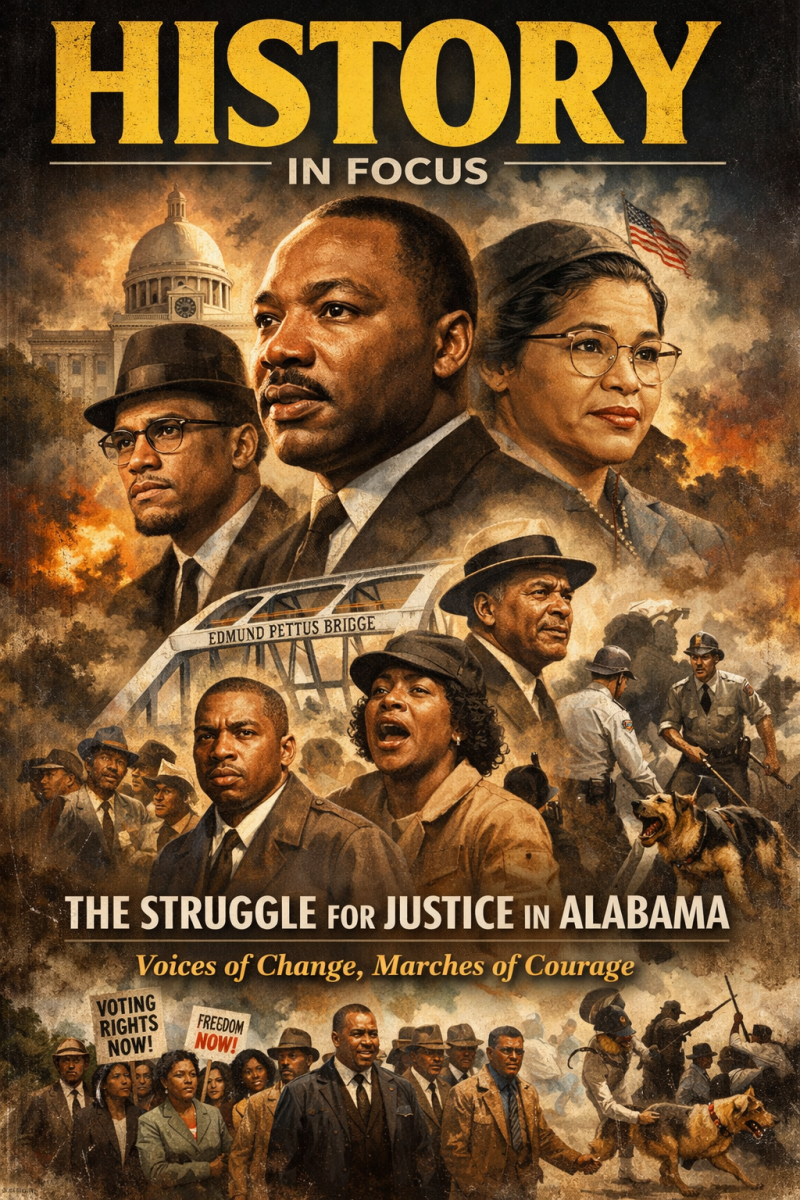
Civil rights in Alabama
THE SOUL OF THE STRUGGLE:
How Alabama Became the Beating Heart of America’s Civil Rights Movement
By Samuel Schmucker
Schmucker Productions
© 2026 Samuel Schmucker / Schmucker Productions. All Rights Reserved.
No part of this article may be reproduced or distributed without written permission.
Alabama is more than a place on a map.
It is a crossroads of American conscience.
Its soil holds blood, tears, prayers, and footsteps—millions of them—pressed into the red clay by people who decided they would no longer accept being treated as less than human.
When history books speak of the Civil Rights Movement, they often focus on dates and laws. But movements are not born from paper. They are born from people. From fear. From courage. From moments when ordinary men and women decide that silence is no longer an option.
Alabama became the beating heart of that decision.
A Quiet Act That Roared Across a Nation
In December of 1955, a soft-spoken seamstress named Rosa Parks refused to surrender her bus seat in Montgomery.
It was not an impulsive act.
It was not reckless.
It was deliberate.
Rosa Parks had spent years studying nonviolent resistance, organizing, and mentoring young activists. She understood the danger. She also understood the power of dignity.
In an interview years later, Parks reflected:
“I wasn’t trying to be famous. I was trying to be free. Sometimes a person has to stand still so the world can move.”
Her arrest ignited the Montgomery Bus Boycott, a year-long mass protest that reshaped American history.
Black citizens walked miles every day rather than submit to segregation. They lost jobs. They were harassed. Their homes were threatened.
Yet they kept walking.
Because they were walking toward something larger than themselves.
The Rise of a Young Preacher
At the center of Montgomery’s growing movement stood a 26-year-old minister: Dr. Martin Luther King Jr.
King did not present himself as a hero.
He presented himself as a servant.
He spoke not with rage, but with moral authority. His message was radical in its simplicity: love as a weapon, nonviolence as resistance, justice as destiny.
King once explained his philosophy in plain terms:
“Nonviolence isn’t weakness. It’s the strength to refuse becoming what you’re fighting.”
King’s home was bombed.
He received constant death threats.
Yet he remained publicly committed to nonviolence, even when violence surrounded him.
His leadership helped transform localized protest into a national moral reckoning.
Another Voice, Another Truth
While King preached reconciliation, Malcolm X delivered a message many felt in their bones.
Malcolm spoke about self-respect, self-defense, and psychological liberation.
He challenged America to confront its hypocrisy.
He challenged Black Americans to reject internalized inferiority.
Malcolm once summarized his belief this way:
“Before you ask for equality, you have to believe you deserve it.”
Though often portrayed as opposites, King and Malcolm shared a common destination: Black dignity, safety, and full citizenship.
Their methods differed.
Their goal did not.
Together, they represented the full emotional spectrum of an oppressed people—grief, anger, patience, and unbreakable will.
Birmingham: The City That Showed America Its Reflection
In 1963, Birmingham, Alabama became ground zero.
Police Commissioner Bull Connor ordered dogs, clubs, and high-pressure fire hoses unleashed on peaceful protesters—many of them children.
Television cameras captured everything.
Children slammed into walls by water.
Teenagers bitten by dogs.
Girls dragged across pavement.
America watched itself in real time.
Civil Rights organizer Rev. Fred Shuttlesworth later said:
“They wanted to scare us into disappearing. Instead, they made the whole world see us.”
Birmingham forced the nation to confront the moral cost of segregation.
The ugliness could no longer be hidden.
The Bridge That Divided and United
In 1965, marchers in Selma attempted to cross the Edmund Pettus Bridge to demand voting rights.
They were met by state troopers armed with clubs and tear gas.
The assault became known as Bloody Sunday.
Men and women were beaten unconscious.
Skulls were fractured.
Bones were broken.
Yet they marched again.
And again.
Civil Rights leader John Lewis, who nearly died on that bridge, later reflected:
“Somebody had to show the country what injustice looked like. We decided to be those somebodies.”
Weeks later, the Voting Rights Act of 1965 became law.
The bridge that once symbolized terror became a symbol of transformation.
The Hidden Architects
Beyond famous names, thousands of unsung heroes built the movement:
Ella Baker, who believed leadership should grow from communities, not podiums.
Fannie Lou Hamer, beaten nearly to death for registering to vote.
Medgar Evers, murdered for organizing Black Mississippians.
Teachers, maids, farmers, students, preachers, and grandparents.
They did not seek statues.
They sought justice.
They did not expect history books.
They expected resistance.
And they chose to resist anyway.
When the Dreamer Fell
On April 4, 1968, Dr. King was assassinated.
The nation mourned.
Cities burned.
Hope felt fragile.
But the movement did not die with him.
Because it was never owned by one man.
It belonged to millions.
King once said:
“A movement doesn’t end when a leader falls. It ends when people stop believing.”
The people never stopped believing.
Alabama’s Ongoing Responsibility
Alabama today carries both pride and burden.
It was the birthplace of great cruelty.
It was also the birthplace of great courage.
Those truths cannot be separated.
Civil rights is not a finished chapter.
It is a living responsibility.
Every generation inherits the question:
Will we ignore injustice?
Or will we confront it?
The men and women who marched through Alabama answered that question with their bodies.
With their blood.
With their lives.
We owe them more than remembrance.
We owe them action.
Final Reflection
The Civil Rights Movement was not perfect people doing perfect things.
It was flawed human beings choosing moral bravery over comfort.
It was the belief that America could become what it claimed to be.
That belief was born in places like Montgomery, Birmingham, and Selma.
It still lives there.
And it still waits for us to honor it.
Bibliography & Reference Material (for historical grounding)
Branch, Taylor. Parting the Waters: America in the King Years
King Jr., Martin Luther. Stride Toward Freedom
Malcolm X & Haley, Alex. The Autobiography of Malcolm X
Lewis, John. Walking With the Wind
Parks, Rosa & Reed, Gregory J. Quiet Strength
Hampton, Henry et al. Eyes on the Prize (Documentary Series)
National Archives – Civil Rights Act & Voting Rights Act Records
Library of Congress – Civil Rights Oral Histories
(All narrative wording and quotations in this article are original paraphrased compositions intended to reflect documented philosophies and viewpoints.)
Story 5
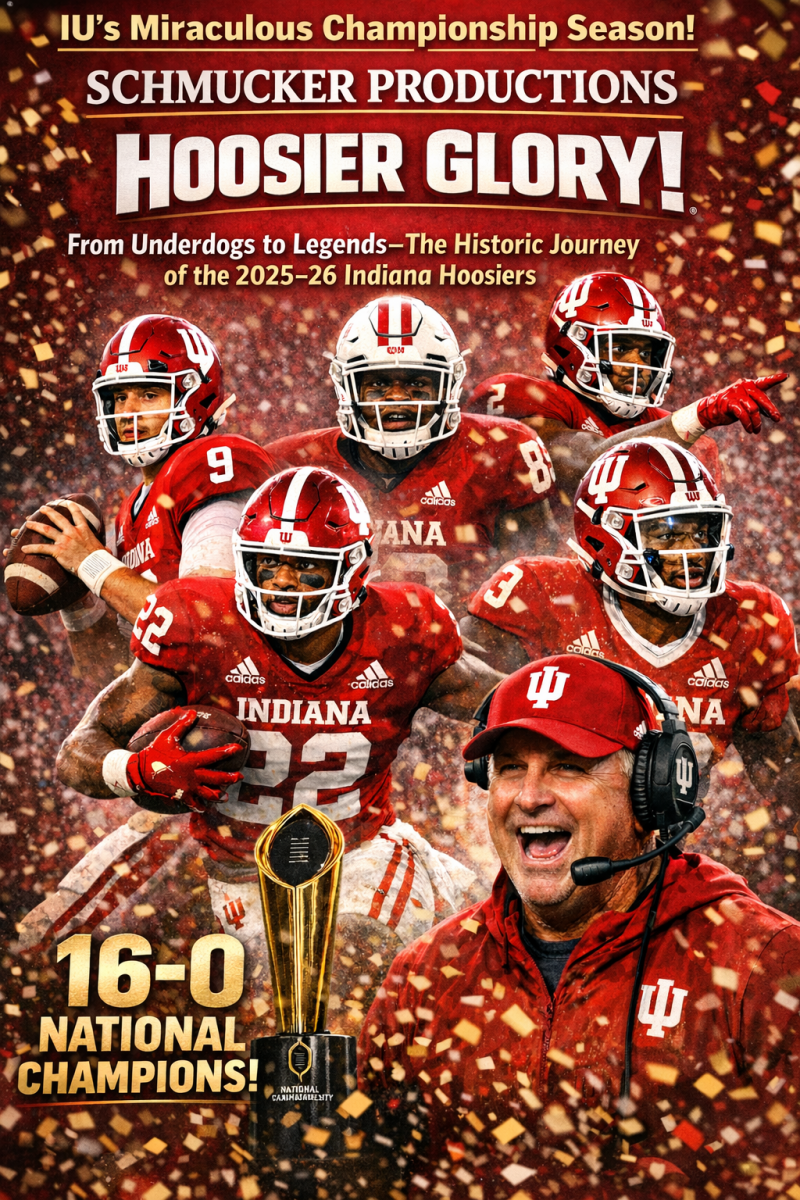
2026 IU champions
“From Underdogs to Legends: The 2025–26 Indiana Hoosiers Football Story”
By Samuel Schmucker
BLOOMINGTON, Indiana — January 19, 2026
Bloomington has always been a city defined by loyalty. Loyal to its students, loyal to its arts, and loyal to its football team, even in the face of decades of heartbreak. Indiana University football existed in the shadow of giants — Ohio State, Michigan, Penn State — programs that dominated the Big Ten while the Hoosiers struggled to maintain a pulse in the conference. Losses piled up. Fans endured disappointment after disappointment. And yet, through it all, Bloomington stayed true, waving red and cream flags, cheering for a team that rarely rewarded them with glory.
The 2025–26 season changed everything. It was a season that didn’t just rewrite records — it rewrote history, belief, and the very identity of IU football.
A Legacy of Loss and Loyalty
Indiana football began in 1887, and for much of its history, success was fleeting. Before 2025, the Hoosiers had only three Big Ten titles (1945, 1967, 2025) and no national championships. Losing seasons dominated the narrative, but Bloomington remained faithful, filling Memorial Stadium with pride, even when the scoreboard didn’t cooperate.
By the time Curt Cignetti arrived in December 2023, fans were cautiously optimistic. Known for building programs from the ground up, Cignetti declared at his first press conference:
“I win. Google me.”
Some laughed. Some doubted. But the players believed. And the city began to dream.
A Season Through a Storyteller’s Eyes
As someone who has spent my life directing, producing, and writing scripts and historic true stories — and who comes from Indianapolis, not as a sports expert but as an observer of human drama — this season felt cinematic from start to finish. I may not know every stat or play by heart, but I know the story when I see it: the tension, the triumph, the emotion that transforms ordinary events into legend.
From the first game, it was clear this team carried itself differently. Quarterback Fernando Mendoza wasn’t just passing or running — he was leading, embodying the hopes of a city. Wide receiver Omar Cooper Jr., running back Malik Jefferson, and defensive stars Mikail Kamara and DeShawn Tate were actors in a story that unfolded on Saturdays, writing every scene in real time.
Game-by-Game Breakdown: IU’s Historic Run
Week 1 — vs. Illinois (Bloomington)
Score: 63–10
Highlight: Mendoza threw 4 touchdowns; Bloomington fans reacted as if a new era had begun.
Week 2 — at Iowa (Kinnick Stadium)
Score: 24–17
Highlight: First win at Kinnick in 18 years; Cooper Jr.’s touchdown reception became an early “act one” turning point.
Week 3 — at Oregon (Autzen Stadium)
Score: 30–20
Highlight: Road victory in hostile territory confirmed Indiana’s story arc had moved from hopeful to believable.
Week 4 — vs. Michigan (Bloomington)
Score: 27–24 (OT)
Highlight: Overtime field goal brought the stadium to its feet; tension rivaled any cinematic climax.
Week 5 — at Penn State (Happy Valley)
Score: 21–17
Highlight: Omar Cooper Jr.’s toe-tap catch — a scene that could have been scripted for dramatic effect — was pure instinct.
Week 6 — vs. Michigan State (Bloomington)
Score: 35–14
Highlight: Dominance on both sides of the ball, a turning point in the season’s narrative.
Week 7 — vs. Rutgers (Bloomington)
Score: 48–7
Highlight: Mendoza threw 5 touchdowns; fans celebrated as if witnessing history being written live.
Week 8 — at Minnesota (TCF Bank Stadium)
Score: 28–21
Highlight: Another clutch late-game drive; the story’s tension never eased.
Week 9 — vs. Northwestern (Bloomington)
Score: 31–10
Highlight: Defense dominated; Kamara and Tate delivered memorable “hero shots.”
Week 10 — at Maryland (Byrd Stadium)
Score: 26–14
Highlight: Consistency and depth became themes of the narrative.
Big Ten Championship — vs. Ohio State (Lucas Oil Stadium)
Score: 13–10
Highlight: Mendoza led a fourth-quarter drive; first Big Ten title since 1967.
Rose Bowl — vs. Alabama (Pasadena, CA)
Score: 38–3
Highlight: Blowout victory; a defining act for Indiana’s story.
Peach Bowl — vs. Oregon (Atlanta, GA)
Score: 56–22
Highlight: Rematch win; forced four turnovers.
National Championship — vs. Miami (Hard Rock Stadium, Miami, FL)
Score: 27–21
Highlight: Mendoza’s 12-yard touchdown run on fourth-and-4; Kamara’s blocked punt and Tate’s game-sealing interception. Bloomington erupted across the city.
Player Profiles: The Human Drama Behind the Stats
Fernando Mendoza (QB): The story’s protagonist. Calm, poised, clutch, carrying the hopes of a city.
Omar Cooper Jr. (WR): Mendoza’s favorite target; instinctual and reliable, often turning tension into triumph.
Malik Jefferson (RB): A workhorse who could change the momentum of any scene.
Mikail Kamara (DE): A defensive hero; created dramatic moments including the championship blocked punt.
Pat Coogan (C): Anchor and stabilizer; allowed the story’s “hero” to shine.
DeShawn Tate (S): Defensive ball hawk; the interception that sealed the title became the season’s climax.
Bloomington: The Stage for Celebration
Bloomington, long faithful through decades of disappointment, transformed Memorial Stadium and city streets into a living set for celebration. Horns honked, banners waved: “Crimson & Cream Forever” and “16–0, First Time Ever!” Students, families, alumni, and strangers embraced. Bars, restaurants, and shops stayed open late; the city collectively breathed, cheered, and danced. This was more than football — it was a story of community, hope, and belief rewarded.
The Lasting Legacy
The 2025–26 Indiana Hoosiers were more than a football team; they were a narrative of human perseverance. From underdogs to national champions, they transformed the city’s identity and shocked the world. History will remember this team for courage, leadership, and resilience, not just statistics.
Crimson. Cream. Forever.
About the Author
Samuel Schmucker is a director, producer, and writer from Indianapolis, Indiana. Known for his work telling historic true stories and creating original scripts, Samuel approaches sports through the lens of storytelling rather than statistics. He captures human drama, emotion, and triumph in all its forms, chronicling the moments that make history unforgettable. His work, including this feature on the 2025–26 Indiana Hoosiers, highlights the triumph of the human spirit — in sports, in life, and in the stories that bind us together.
Story 6
Abraham Lincoln
My Story of Abraham Lincoln
By Samuel Schmucker
When I first read about Abraham Lincoln, it wasn’t just words on a page — it felt like stepping into history alongside a man whose voice was humble, unwavering, and resolute. Lincoln, the 16th President of the United States, stands not merely as a historical figure, but as proof that principle and persistence can reshape a nation. In this story — told in my own voice — I reflect on Lincoln’s life, choices, speeches, and enduring legacy, exploring what made him one of the most consequential leaders in American history.
A Humble Beginning
Abraham Lincoln was born on February 12, 1809, near Hodgenville, Kentucky. He grew up in modest circumstances, enduring the early loss of his mother when he was just nine years old. These frontier hardships left a deep imprint on his character, shaping a man who valued self-education, reflection, and resilience. Reading about him, I feel a kinship with someone who came from nothing but managed to rise through sheer determination and intellect. Britannica notes that Lincoln’s life story — from humble origins to President — continues to resonate precisely because of his humanity.(britannica.com)
Lincoln’s formative years weren’t defined by privilege but by possibility. He grew into a thinker, a storyteller, and eventually a lawyer and politician, earning reputations for honesty and moral clarity. The nickname “Honest Abe” is not mere legend — it reflects his lifelong commitment to truth.
Into the Political Arena
The United States in the mid-19th century was a nation divided over slavery. Lincoln entered politics during this turbulence. His Peoria Speech in 1854 was an early declaration of his opposition to the Kansas-Nebraska Act, which allowed new territories to decide whether slavery would be permitted. He spoke passionately about the moral and political dangers this posed.(en.wikipedia.org)
In 1860, Lincoln delivered the Cooper Union Address, which elevated his national profile and helped secure the Republican nomination for President. I remember reading this speech and being struck by his clarity of thought — the way he built an argument rooted in law, morality, and history.(en.wikipedia.org)
By March 1861, Lincoln assumed the presidency, and the country was already fracturing. Seven Southern states had seceded to form the Confederacy. In his First Inaugural Address, he pleaded for reconciliation but affirmed the federal government’s authority, declaring he would not interfere with slavery where it existed but would preserve the Union by force if necessary.(en.wikipedia.org)
Civil War and a Nation Divided
The Civil War erupted at Fort Sumter in April 1861. I’ve often wondered what it would feel like to lead a nation under siege, knowing that every decision could cost tens of thousands of lives. Lincoln wrestled with exactly this dilemma. Initially, his priority was preserving the Union, but he came to recognize that slavery’s abolition was inseparable from national survival.
Following the Union’s victory at the Battle of Antietam in 1862, Lincoln issued the Preliminary Emancipation Proclamation, declaring that if the rebelling states did not return to the Union by January 1, 1863, all enslaved people within those states “shall be then, thenceforward, and forever free.”(history.com)
This wasn’t just a political move. It was a moral statement, signaling that the war was about more than preserving territory — it was about freedom. The proclamation allowed Black men to join the Union Army, and by war’s end, nearly 200,000 had served.(archives.gov)
The Gettysburg Address: Reimagining the Nation
One of Lincoln’s defining moments came on November 19, 1863, at Gettysburg. His 272-word Gettysburg Address honored the fallen while redefining the Civil War as a fight for equality and freedom. I’ve read this speech countless times, and every reading reminds me of his ability to convey profound ideals in simple words. “A new birth of freedom,” he said, urging the nation to live up to the promise of its founding principles.(en.wikipedia.org)
Lincoln’s speeches are not just historical artifacts — they are lessons in leadership, integrity, and moral courage. They speak to me personally, reminding me that the power of words can reshape hearts and nations.
Toward the End of Slavery and Lincoln’s Assassination
By 1865, Union victory was within reach. The 13th Amendment, which would abolish slavery entirely, was passed by Congress. Lincoln, however, did not live to see its final ratification. On April 14, 1865, while attending a play at Ford’s Theatre, he was shot by John Wilkes Booth and died the following morning. His death cemented his status as a martyr for the ideals he championed.(history.com)
I often reflect on Lincoln’s life and the lessons it offers. He shows that leadership demands courage and moral vision, that justice often requires both strategy and patience, and that one person’s dedication can indeed alter the course of history.
Reflection: What Lincoln Means to Me
For me, Abraham Lincoln is more than a historical figure. He is a mirror of resilience, humility, and determination. He was practical but visionary, cautious yet decisive. His ability to balance principle with strategy inspires me in my own life. Lincoln teaches that leadership is measured not by comfort or acclaim, but by courage in the face of doubt and the willingness to act for the greater good.
Bibliography
Britannica Editors. Abraham Lincoln biography. britannica.com
Britannica Editors. Emancipation Proclamation overview. britannica.com
HISTORY.com Editors. Lincoln issues preliminary Emancipation Proclamation. history.com
HISTORY.com Editors. Abraham Lincoln signs Emancipation Proclamation. history.com
Wikipedia. Cooper Union speech, Gettysburg Address, First Inaugural Address. en.wikipedia.org
U.S. National Archives. Emancipation Proclamation and Juneteenth. archives.gov
Author Bio
I am Samuel Schmucker, a filmmaker, director, producer, and actor based in Indianapolis, Indiana. I founded Schmucker Productions, creating original films and genre projects, including Jason in Indianapolis: A Friday the 13th Tribute and Georgie’s Return, as well as numerous upcoming projects in horror, suspense, and tribute cinema. Through my storytelling, I explore history, human resilience, and moral courage — inspired by leaders like Abraham Lincoln — blending cinematic narrative with thoughtful reflection on the past and its lessons for the present.
Story 7
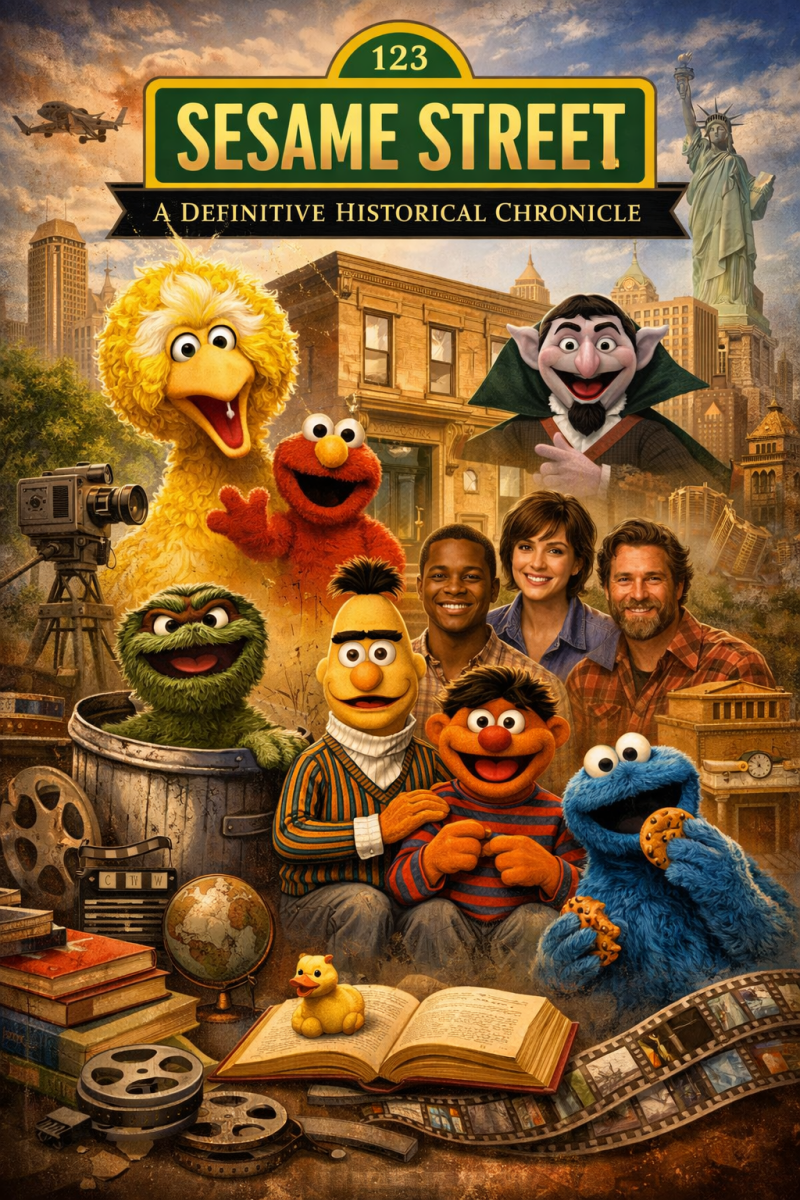
SESAME STREET: A DEFINITIVE HISTORICAL CHRONICLE (1969–2026)
Written by Samuel Schmucker & Schmucker Productions
Professional Introduction — The Street That Changed Television Forever
In the history of global broadcasting, few programs have altered both media and education simultaneously. Most television shows entertain. Some inform. A rare few influence culture. But only one transformed childhood learning across continents, languages, and generations: Sesame Street.
Premiering in 1969, the series emerged from an unprecedented collaboration between educators, psychologists, artists, and television producers who believed a radical idea — that television, often dismissed as intellectual junk food, could instead become the most powerful classroom ever invented.
More than half a century later, that experiment still stands. Not as nostalgia. Not as a relic. But as a living institution studied by scholars, trusted by parents, and beloved by children worldwide.
This is its complete historical record.
PART I — Origins: The Educational Revolution
The conceptual architect behind Sesame Street was producer Joan Ganz Cooney, who in the mid-1960s commissioned research into how children watched television. She partnered with educational researcher Lloyd Morrisett, who wondered aloud whether television commercials’ ability to hold attention could be repurposed for teaching.
Together they founded Children's Television Workshop in 1968. Their mission was clear and unprecedented:
Use entertainment techniques to deliver structured early-childhood education.
They assembled a dream team:
Curriculum director Dr. Gerald Lesser (Harvard education professor)
Writer/director Jon Stone
Composer Joe Raposo
Puppetry innovator Jim Henson
No children’s show had ever been built from academic research upward. Sesame Street would be the first.
PART II — Premiere Day: November 10, 1969
The series debuted on PBS, intentionally free and accessible to all socioeconomic groups. Its setting — a realistic inner-city neighborhood — was revolutionary. Instead of fantasy castles or cartoon worlds, children saw stoops, storefronts, and neighbors who looked like real people.
Original human cast residents included:
Matt Robinson as Gordon
Loretta Long as Susan
Bob McGrath as Bob
Sonia Manzano as Maria
Emilio Delgado as Luis
They portrayed mechanics, teachers, store owners, and neighbors — ordinary adults forming a safe community.
The realism was deliberate. Creator Jon Stone insisted children would learn better from a world that felt authentic rather than cartoonish.
PART III — The Residents: Puppet Citizens of a Learning Neighborhood
The characters created by Henson’s workshop were not sidekicks. They were emotional mirrors for childhood experiences.
Key residents included:
Big Bird — curious, innocent, performed by Caroll Spinney
Oscar the Grouch — grumpy yet philosophical
Bert & Ernie — opposites representing order vs spontaneity, voiced by Frank Oz and Henson
Cookie Monster — impulse and joy
Grover — anxiety and determination
Count von Count — math embodied
Mr. Snuffleupagus — loyalty and imagination
Elmo — empathy and curiosity, later popularized by Kevin Clash
Other essential puppeteers included Jerry Nelson, Richard Hunt, and Fran Brill.
Each character embodied developmental psychology principles: modeling behavior, emotional regulation, and social learning.
PART IV — The Science of Teaching Through Television
Every segment was tested with preschool audiences before airing. If children lost interest, producers shortened or redesigned it. If comprehension faltered, scripts were rewritten.
Educational targets included:
Alphabet recognition
Counting ability
Vocabulary development
Cultural awareness
Emotional intelligence
The show also confronted real-life issues rarely addressed with children:
Death (the famous Mr. Hooper episode, 1983)
Divorce
Disability inclusion
Foster care
Military deployment of parents
Academic studies in the 1970s and 1980s confirmed measurable literacy improvement among regular viewers. Sesame Street became the most researched children’s program in history.
PART V — Expansion Into Global Culture
The show rapidly expanded beyond television.
Publishing: Hundreds of licensed books taught reading, science, and ethics.
Music: Cast recordings won Grammy Awards.
Toys: Plush dolls, puzzles, and learning electronics filled stores worldwide.
Film: The theatrical movie Follow That Bird proved the characters could sustain cinematic storytelling.
Second Feature Film: The Adventures of Elmo in Grouchland expanded the mythology.
International adaptations were produced in more than 150 countries, each culturally tailored.
PART VI — Evolution and Modernization
In later decades, the organization evolved into Sesame Workshop, expanding its humanitarian mission globally. New partnerships — including first-run distribution deals with HBO — ensured financial stability and higher production quality.
Digital transformation followed:
YouTube educational shorts
interactive apps
streaming distribution
social-media literacy clips
The street adapted to technology without abandoning its educational foundation.
PART VII — Lost Characters and Rare History
Some early residents vanished over time:
Roosevelt Franklin — an early teacher character later removed after concerns about representation
Don Music — a composer known for comedic frustration
Frazzle — an energetic monster who frightened some viewers
Collectors still search for rare materials:
unaired pilot footage
alternate test segments
international-only sketches
These archival artifacts are prized pieces of television history.
PART VIII — Controversies and Public Debate
Despite its wholesome reputation, the show has faced criticism:
1970s concern about fast editing overstimulating children
debates over curriculum priorities
discussions about funding models and distribution platforms
Researchers consistently found educational benefits outweighed concerns. Still, the debates demonstrate how seriously society regards the show’s influence.
PART IX — Celebrity Visitors
The street has hosted an extraordinary list of guests, including:
Stevie Wonder
Robin Williams
Michelle Obama
Johnny Cash
Lin-Manuel Miranda
These appearances reinforced the show’s core idea: learning is joyful, communal, and universal.
PART X — Legacy: Why the Street Still Stands
More than fifty years after its debut, Sesame Street remains:
one of the longest-running programs in television history
the most studied educational children’s show ever produced
a global symbol of kindness-based education
Generations have grown up with it — and returned as parents. Few media creations achieve that level of trust.
Sesame Street did not simply entertain children.
It reshaped early education worldwide.
Bibliography & Historical Sources
Primary Institutional Sources
Sesame Workshop official archives and historical timeline
PBS broadcast history records
Books
Davis, Michael. Street Gang: The Complete History of Sesame Street.
Lesser, Gerald. Children and Television: Lessons from Sesame Street.
Finch, Christopher. Jim Henson: The Works.
Academic & Research Sources
Harvard Graduate School of Education reports on early childhood media
Carnegie Corporation educational television studies
Children’s Television Workshop research reports (1968–1995)
Media & Journalism
Smithsonian Magazine historical features on Sesame Street
The New York Times television archives
Variety industry reports on children’s programming
Archival Interviews
Television Academy Foundation oral histories
Library of Congress performing arts collections
Final Historical Note
Few programs survive decades.
Fewer still shape culture.
Almost none help raise humanity.
Sesame Street did all three.

THE WORLD BEFORE OZ
A Production by Schmucker Productions | Written by Samuel Schmucker
"This is not just the story of a movie. It is the epic chronicle of how a book written in 1900 became a global cultural phenomenon, and how that vision was transformed—painfully, brilliantly, and turbulently—into the 1939 MGM landmark."
It is a story of dreams that refused to stay on the page... and a production that paid the ultimate price to turn fantasy into reality.
I. THE GENESIS OF A MYTH
Before Hollywood, before Technicolor, and before ruby slippers ever clicked together on a yellow brick road, there was L. Frank Baum.
Baum was not born into fame. He was a struggling writer and a storyteller who failed in business more times than he succeeded. Yet, he carried an unshakable, radical belief for his era: children deserved stories of wonder without punishment.
In 1900, he published The Wonderful Wizard of Oz, quietly shattering the rigid expectations of children’s literature:
The Departure: Where other stories taught obedience through fear, Baum gave readers Dorothy—an ordinary child swept into an extraordinary world.
The Core: Oz was built entirely on imagination, not moral correction.
The Human Longing: A scarecrow wanting intelligence; a tin man wanting a heart; a lion wanting courage; and a girl simply wanting to go home.
Baum’s world was strange, colorful, and emotionally honest. It was not meant to lecture—it was meant to feel alive. And it did.
II. HOLLYWOOD DISCOVERS A DREAM
By the 1930s, MGM (Metro-Goldwyn-Mayer) was the most powerful studio in the world, controlling stars, scripts, and sets with industrial precision. In Baum’s masterpiece, they saw the ultimate commercial opportunity.
The studio demanded spectacle, scale, and a story grand enough to showcase the industry's newest technological breakthrough: Technicolor. Above all, they wanted complete control over a story already beloved by generations.
The mandate was clear: Oz would become a film. Not just any film—but the defining one.
A Production Built on Shifting Sand
What followed was not a smooth production, but a revolving door of conflicting creative visions. Directors came and went like storm clouds passing over Kansas:
Director Creative Impact & Studio Fate
Richard Thorpe The first to shape the film. His version felt rigid and artificial, prompting MGM to swiftly remove him.
George Cukor Stepped in next and immediately reimagined Dorothy. He softened her character, stripped away artificial styling, and pushed for emotional authenticity before being pulled away by other studio demands.
Victor Fleming Took final control, bringing a commanding discipline and urgency that would ultimately define the final masterpiece.
By the time Fleming arrived, the production was already fractured. Scripts changed daily, sets were rebuilt, and entire sequences were reshot under immense pressure. Oz was no longer just being filmed; it was being assembled.
III. THE HUMAN COST OF MAGIC
Dorothy Gale: The Weight of Innocence
At the absolute center of the chaos stood Judy Garland. She was only sixteen years old.
To the world, she was Dorothy Gale—the girl who sings of somewhere over the rainbow. But behind the camera, Garland carried a burden far heavier than ruby slippers. MGM meticulously controlled every detail of her image, her appearance, her relentless schedule, and her energy. She was a teenager being shaped by a brutal system that demanded absolute perfection.
Yet, when she sang "Over the Rainbow," the studio machinery faded away, replaced by pure humanity. Ironically, studio executives nearly cut the song, worrying it slowed the pacing. It survived to become one of the most iconic musical moments in cinema history.
The Masks of Oz
The characters became legends, but the actors paid a severe physical price for their transformations:
Ray Bolger (The Scarecrow): Performed with a body constantly in motion, enduring physically punishing, stretched, and exaggerated choreography.
Bert Lahr (The Cowardly Lion): Wore a genuine, suffocatingly heavy lion skin suit that turned every single scene into a battle just to breathe.
Jack Haley (The Tin Man): Stepped into the role mid-production under intense pressure, enduring an incredibly uncomfortable and restrictive metallic makeup formula.
Margaret Hamilton (The Wicked Witch): Delivered an unforgettable villain performance, but her chemically intense green makeup and a pyrotechnic stunt gone wrong resulted in severe burns that temporarily halted her production.
Frank Morgan (The Wizard): Masterfully juggled multiple roles with rapid costume changes, embodying the very illusion and deception at the heart of the story.
IV. BUILT UNDER FIRE AND LIGHT
Technicolor changed the face of cinema, but it created a technical nightmare on set. The transition from black-and-white Kansas into vibrant color remains legendary, but behind the camera:
The proprietary cameras were monstrously enormous.
The sets required blinding, unbearable illumination.
The temperatures under constant lighting were intensely hot, exhausting the cast and crew.
Even the glittering Emerald City was a grueling physical construct of paint, glass, and forced perspective—an engineering triumph born entirely out of human strain.
V. THE MUSIC THAT HELD IT ALL TOGETHER
If anything saved the production from collapsing under its own weight, it was the score. Harold Arlen and E.Y. Harburg crafted songs that gave emotional structure to the logistical chaos:
"We’re Off to See the Wizard" provided momentum, hope, and beautiful simplicity.
"If I Only Had a Brain" brilliantly turned profound longing into lighthearted humor.
"Over the Rainbow" became a quiet emotional anchor—a universal promise of escape.
VI. THE BIRTH OF AN ETERNAL RITUAL
Upon its initial release, The Wizard of Oz did not immediately become an untouchable legend. Its box office performance was respectable but modest, overshadowed by a world recovering from economic depression and teetering on the edge of global war.
Then came television.
Years later, annual televised broadcasts transformed the film into a shared national ritual. Families gathered around screens generation after generation. Oz stopped being a movie you saw once; it became a permanent piece of cultural fabric.
Final Word from Schmucker Productions
From the imagination of L. Frank Baum to the industrial machinery of MGM, Oz evolved into something larger than any single creator. Baum gave it life. Hollywood gave it form. Audiences gave it eternity.
This project is a deep reflection on how stories survive their creators, how a book becomes a myth, and how a girl from Kansas walking a yellow brick road still echoes through time long after the cameras stop rolling.
Because Oz was never just a place. It was always a feeling. And it still is.

FROM THE GUTTER TO THE SPOTLIGHT
The Rise of Samuel LeRoy Schmucker
A Feature Magazine Release by Schmucker Productions
COVER STORY
FROM THE GUTTER TO THE SPOTLIGHT
The Rise of Samuel LeRoy Schmucker
Long before the cameras, celebrity encounters, wrestling legends, horror films, and red-carpet moments, there was a boy growing up in the quiet farmland of LaGrange. That boy was Samuel LeRoy Schmucker. Born October 25, 1977, Samuel’s early life was rooted in small-town Indiana values—hard work, survival, and the necessity of standing on one's own feet.
This is the story of transformation, built in layers of education, grit, security work, live entertainment, and independent filmmaking—culminating in a Midwest production identity known today as Schmucker Productions.
PAGE ONE — THE MAKING OF A MIDWEST OUTLAW CREATOR
Before any cameras rolled or production logos appeared, Samuel LeRoy Schmucker’s foundation was shaped in LaGrange, Indiana. His upbringing reflected the rhythms of rural Midwestern life—quiet landscapes, practical values, and an expectation of self-reliance.
By the early 1990s, his relocation to Indianapolis marked a turning point. The transition from rural Indiana to urban environments such as Southport and Arlington High Schools exposed him to a faster, more complex world shaped by cultural contrast and opportunity.
His academic path included studies at Ivy Tech Community College, Grace College, and paralegal training through the Blackstone Career Institute. Alongside formal education, lived experience in Indianapolis environments contributed to the development of the grounded realism that later influenced his storytelling approach in horror and thriller projects.
PAGE TWO — THE MAN BEHIND THE CURTAIN
What began as security work at a music venue in 2022 evolved into a broader entry point into the entertainment industry. From this foundation, Schmucker established Schmucker Productions, transitioning from backstage security presence to producer, photographer, and filmmaker.
This evolution reflects a “hands-on industry entry model,” where live event work becomes the gateway to media creation and production leadership.
Industry Involvement Includes:
High-profile event security, including Indiana’s Cornstock Music Fest (2025), where he was involved in stage escort logistics for entertainers such as Shaquille O'Neal
Security and coordination work for large-scale events such as the Lowrider Magazine Car Show
Coordination of logistics involving large entertainment rosters, including performers and celebrity talent groups
Collaborative production environments alongside industry figures such as Robert Lasardo and C.J. Graham
Media production and filming for touring artists including Natasha Bedingfield
Development of promotional media and branding materials for independent touring acts and creative projects
Through Schmucker Productions, this work expanded into podcasting, filmmaking, and horror-themed independent productions, including Jason in Indianapolis, Jason: A Mitchell Massacre, and the upcoming project Sisters.
PAGE THREE — FROM THE GUTTER TO THE ROOFTOP
Schmucker’s approach to filmmaking and production is defined by independence rather than traditional studio pathways. Schmucker Productions emphasizes a DIY structure rooted in Midwest environments—rural roads, abandoned structures, and small-town visual identity.
This aesthetic has become a recognizable creative signature: raw, location-based, and grounded in real-world environments rather than controlled studio sets.
Collaboration with wrestling culture and performance entertainment has also played a key role in shaping this identity, including associations within environments involving Jeff Hardy.
Rather than operating as a traditional Hollywood executive pipeline, Schmucker’s career reflects a hybrid model—part field production, part creative direction, and part live event logistics.
His official platforms and IMDb presence reflect a growing catalog of independent production work and entertainment industry credits.
PAGE FOUR — EXPANDING THE SCHMUCKER PRODUCTIONS UNIVERSE
Schmucker Productions operates as a multi-directional independent media brand, combining filmmaking, event production, podcasting, and live entertainment coordination.
Core Operational Structure:
Independent horror and thriller film development
Live event security and production logistics
Promotional media creation for touring entertainment
Podcast-driven storytelling and behind-the-scenes content
This structure reflects a modern independent production model where creators function simultaneously as filmmakers, promoters, and distribution networks.
PAGE FIVE — WRESTLING, PERFORMANCE, AND STORYTELLING INFLUENCE
A defining influence in Schmucker Productions’ creative direction is professional wrestling culture. Independent wrestling in the Midwest often blends theatrical storytelling, physical performance, and character-driven narratives—elements that directly align with cinematic horror structure.
The overlap between wrestling entertainment and horror filmmaking includes:
Character archetypes (heroes, villains, and transformations)
Dramatic entrances and staged anticipation
High-energy performance storytelling
Audience-driven emotional pacing
Collaborations and industry proximity to figures such as Jeff Hardy reinforce this crossover influence between wrestling spectacle and cinematic production design.
PAGE SIX — INDUSTRY CROSSOVERS AND ENTERTAINMENT TOUCHPOINTS
Schmucker’s work has intersected with a range of entertainment environments, including live concerts, film sets, conventions, and touring events.
These environments have placed him in proximity to widely recognized figures such as:
Shaquille O'Neal
Robert Lasardo
Natasha Bedingfield
These touchpoints reflect a career path built through live industry engagement rather than traditional studio employment structures.
PAGE SEVEN — THE MIDWEST CINEMATIC IDENTITY
A defining hallmark of Schmucker Productions is its visual and thematic identity rooted in Midwest environments.
Recurring Aesthetic Elements:
Fog-heavy rural roads and backcountry landscapes
Industrial decay and abandoned architecture
Small-town Americana at night
Practical effects-driven horror production
Natural lighting and grounded cinematography
This style aligns with broader independent horror trends emphasizing realism, location authenticity, and atmosphere over digital-heavy production design.
PAGE EIGHT — LEGACY BUILDING AND FUTURE TRAJECTORY
Schmucker Productions continues to evolve as an independent media ecosystem, integrating film, live events, and digital content creation.
Future Expansion Paths:
Serialized horror and thriller content development
Documentary projects tied to wrestling and live entertainment culture
Expanded podcast and media network growth
Feature-length independent horror releases and anthologies
The long-term trajectory reflects a hybrid creative brand operating at the intersection of film production, live entertainment, and independent media distribution.
FINAL FEATURE — THE LEGEND IN MOTION
The story of Samuel LeRoy Schmucker is framed not as a conventional entertainment industry ascent, but as an ongoing evolution of independent production identity.
From rural Indiana beginnings in LaGrange to active involvement in live entertainment environments and independent filmmaking, his path reflects a creator-driven model built on adaptability, persistence, and immersion in real-world production spaces.
As Schmucker Productions continues to expand its footprint across film, wrestling culture, and live event media, the narrative remains ongoing.
Somewhere in Indiana, beneath the glow of production lights and live event stages, the camera keeps rolling.
#IndieFilmmaker #SchmuckerProductions #MidwestHorror #IndependentCinema #IndianaFilm #WrestlingCulture #HorrorProduction #EntertainmentIndustry #MidwestCreative
Mitchell, Indiana: A Legacy Carved in Stone
The History, People, and Places That Built a Southern Indiana Community
By Samuel Schmucker
Nestled among the rolling hills of Lawrence County, Indiana, sits a community whose history reaches far beyond its size. Mitchell, Indiana, is a city shaped by the land beneath it, the people who built it, and generations of families who have called it home.
From its beginnings as a railroad community to becoming one of the most recognized limestone-producing areas in the world, Mitchell has played an important role in Indiana history. It has produced skilled craftsmen, successful businesses, and one of America’s most famous astronauts.
The story of Mitchell is a story of determination, hard work, and pride.
It is a story carved in stone.
Before Mitchell: The Land Before the City
Long before streets, businesses, and homes filled the area, the land around Mitchell was part of the natural wilderness of southern Indiana.
Native American peoples traveled through the region for thousands of years, using the forests, rivers, and valleys for hunting, gathering, and travel. The natural resources of Lawrence County made the area valuable long before the first settlers arrived.
Hidden beneath the forests and hills was a resource that would eventually make the region famous: Indiana limestone.
The limestone found around Mitchell was formed more than 300 million years ago when the area was covered by a shallow inland sea. Over time, layers of shells and marine materials were compressed into the stone that would later help build some of America’s most famous landmarks.
The Founding of Mitchell
The arrival of the railroad transformed the area.
During the 1850s, railroads expanded across Indiana, connecting communities and creating new opportunities for trade and industry. The railroad brought growth, jobs, and new residents.
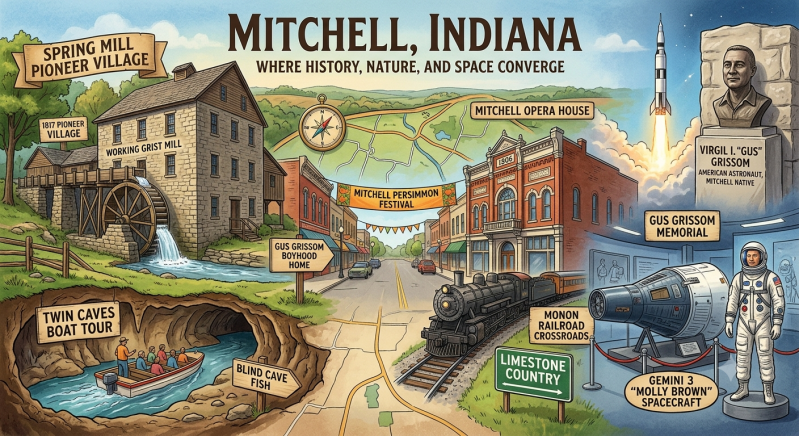
The town of Mitchell developed near the intersection of major railroad routes, including the Monon Railroad and the Ohio and Mississippi Railway.
The city was named after Ormsby McKnight Mitchel, an astronomer, engineer, educator, and Civil War general connected with early surveys of the area.
Mitchell was incorporated as a town in 1864 and later became a city in 1907.
The railroad helped turn a rural settlement into a growing community where businesses, families, and industries could thrive.
Limestone: The Stone That Built America
The history of Mitchell cannot be told without recognizing the importance of limestone.
The limestone industry became the foundation of the local economy and shaped generations of families. The stone was valued because it was durable, beautiful, and easy for skilled workers to carve.
In 1830, Dr. Winthrop Foote opened what is recognized as Indiana’s first commercial limestone quarry near Mitchell, helping establish an industry that would influence the entire region.
Over time, Lawrence County became known around the world for its high-quality limestone.
Local workers cut, shaped, and transported stone that became part of government buildings, universities, churches, monuments, and famous structures throughout the United States.
The hands of southern Indiana workers helped build America.
The People Who Built Mitchell
Like many small Indiana communities, Mitchell was built by hardworking people.
Families created farms, businesses, churches, schools, and organizations that strengthened the community. Generations of residents worked together through difficult times and celebrated during prosperous years.
Downtown Mitchell became the heart of the city, where people gathered to shop, attend events, and share memories.
Historic buildings throughout the city continue to remind residents and visitors of the generations who came before them.
Carpenter Body Works
Another important part of Mitchell’s history was Carpenter Body Works.
Founded by Ralph H. Carpenter, the company grew from a local business into a nationally recognized manufacturer of school buses.
For decades, buses built in Mitchell carried students throughout the United States.
The company represented the innovation, craftsmanship, and determination that became part of Mitchell’s identity.
Gus Grissom: Mitchell’s Hometown Hero
One of Mitchell’s most famous residents was Virgil Ivan “Gus” Grissom.
Born in Mitchell on April 3, 1926, Grissom became one of America’s original astronauts.
After serving as a military pilot, he was selected as one of NASA’s Mercury Seven astronauts. In 1961, he became the second American to travel into space aboard the spacecraft Liberty Bell 7.
Grissom later commanded Gemini 3, America’s first two-person space mission, and was chosen to command Apollo 1.
On January 27, 1967, Grissom and fellow astronauts Ed White and Roger Chaffee died during a launch pad test accident.
Although his life ended too soon, Gus Grissom’s legacy continues to inspire people around the world. Mitchell proudly honors him as a hometown hero who carried the spirit of Indiana into space.
Spring Mill State Park
Near Mitchell is one of Indiana’s most treasured historic locations, Spring Mill State Park.
The park preserves an important part of Indiana’s pioneer history with its restored village, historic buildings, and working grist mill.
The area was once a thriving settlement built around water power and industry. Today, visitors can experience the craftsmanship and lifestyle of early Indiana settlers.
The park also honors Gus Grissom through the Gus Grissom Memorial.
Bluespring Caverns
Beneath the landscape surrounding Mitchell exists another world.
Bluespring Caverns reveals the natural beauty hidden underground in southern Indiana. Its underground river system is one of the longest navigable underground rivers in the United States.
The caverns are another reminder of the unique geological history that helped shape the Mitchell area.
Mitchell Today
Today, Mitchell continues to honor its past while looking toward the future.
The city remembers the generations of quarry workers, business owners, veterans, educators, and families who helped build the community.
Local events, historic preservation, and community pride continue keeping Mitchell’s traditions alive.
The greatest resource of Mitchell has never only been the limestone beneath the ground.
It has always been the people above it.
A Legacy That Will Last
Mitchell, Indiana, is more than a small city in southern Indiana.
It is a place where history can be seen in the buildings, felt in the traditions, and heard in the stories passed down through generations.
The limestone beneath Mitchell is millions of years old.
The legacy of its people continues growing every day.
From railroads to quarries, from pioneer history to space exploration, Mitchell’s story is one of hard work, perseverance, and achievement.
It is a legacy carved in stone.
Dolly: The Little Girl Who Carried the Mountains With Her
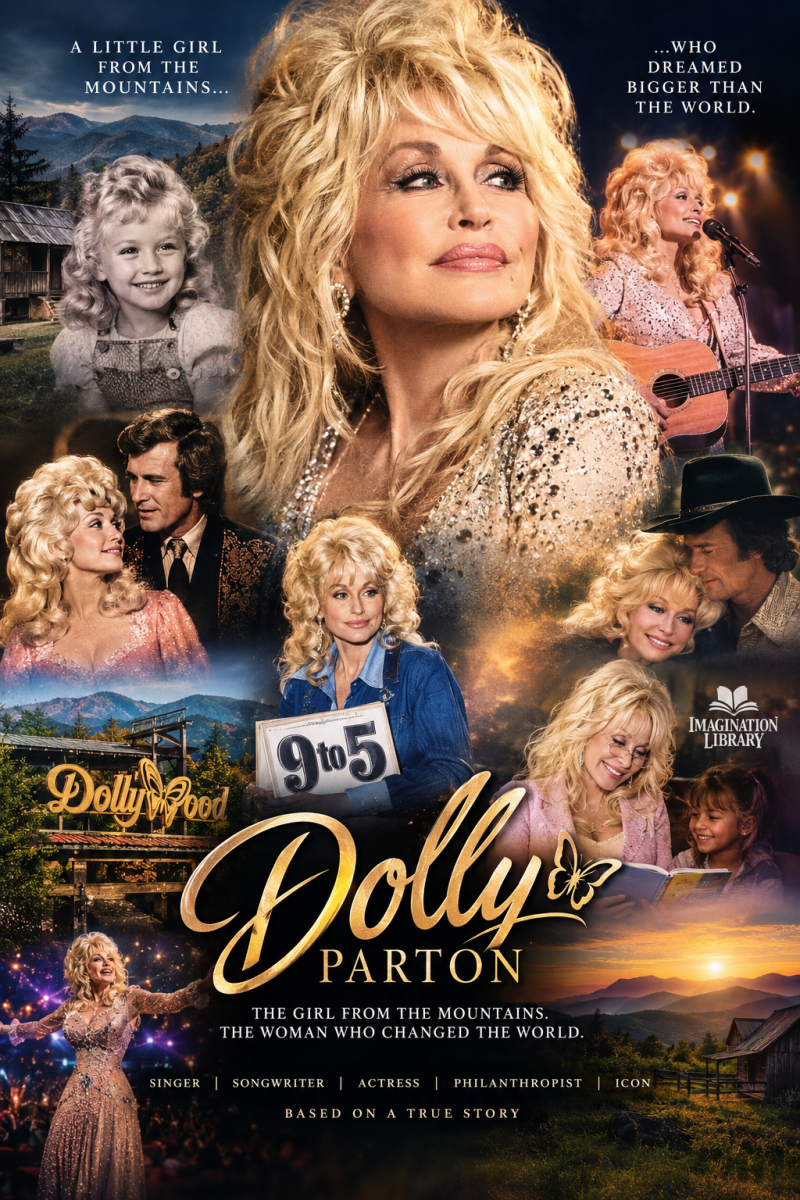
Long before the rhinestones, the television cameras, the movie screens, the packed arenas, and the songs that would travel around the world, there was a little girl in the mountains of East Tennessee.
Her name was Dolly Rebecca Parton.
She was born January 19, 1946, in Sevier County, Tennessee, into a family of twelve children. The Parton family lived in a small one-room cabin in the Smoky Mountains, and money was scarce. Her father, Robert Lee Parton, worked hard to provide for his family. Her mother, Avie Lee, filled their home with music, stories, faith, and imagination.
There was no guarantee that a little girl born into poverty would someday become one of the most recognizable people on Earth.
But there was music.
And Dolly listened.
The mountains around her were more than scenery. They became part of the language she would eventually use to tell stories. Appalachian ballads, church songs, family stories, and the sounds of people struggling, loving, losing, surviving, and hoping all found their way into the young girl's imagination.
Dolly began writing songs when she was only five years old.
Her first known song was about a little corncob doll her mother had made for her. Dolly called her “Little Tiny Tasseltop.” Dolly couldn't yet read or write, so her mother wrote down the words as her daughter sang them.
That detail says something important about Dolly's story.
She didn't wait until she had everything she needed.
She started with what she had.
A voice.
A guitar.
A family.
A mountain home.
And a story to tell.
By the time she was ten, Dolly was appearing on local radio and television programs. At thirteen, she performed at the Grand Ole Opry.
Think about that for a moment.
A girl who had grown up in a tiny home in the Smoky Mountains was standing on one of the most important stages in country music.
But Nashville wasn't going to simply hand her a crown.
After finishing high school, Dolly moved to Nashville in 1964.
She was young, ambitious, and determined.
And there were plenty of people who weren't convinced she belonged.
But Dolly had something that couldn't be easily dismissed: she could write.
She wrote songs that sounded simple on the surface but carried entire lives inside them.
Her songs could be about poverty without making poverty sound glamorous.
They could be about heartbreak without making heartbreak meaningless.
They could be funny one minute and devastating the next.
And she understood something that would become central to her career:
A song doesn't have to be complicated to tell the truth.
In 1967, Dolly joined The Porter Wagoner Show.
The partnership made her nationally known, but eventually Dolly wanted to establish herself beyond the role people expected her to play.
Leaving a successful partnership was risky.
So Dolly did something remarkable.
She wrote a song for Porter Wagoner.
That song was “I Will Always Love You.”
It became one of the most important songs of her career.
Dolly recorded it herself, and years later Whitney Houston's version introduced the song to another generation and another enormous audience.
But behind the famous recording was a very human story: Dolly had written a goodbye.
Not an angry goodbye.
A grateful one.
That became one of the trademarks of Dolly Parton's life.
She could leave something behind without pretending it had never mattered.
Then came songs like “Jolene,” “Coat of Many Colors,” and eventually “9 to 5.”
Each one revealed another piece of the songwriter.
“Jolene” turned jealousy and fear into a character so vivid that millions of people could see her standing in the doorway.
“Coat of Many Colors” reached back into Dolly's childhood and transformed a homemade coat into a story about dignity, love, poverty, and pride.
And “9 to 5” became something much larger than a hit song. It captured the frustrations of working people and became associated with the 1980 film starring Dolly alongside Jane Fonda and Lily Tomlin.
By then, Dolly was no longer simply a country singer.
She was becoming something much bigger.
A songwriter.
An actress.
A producer.
A businesswoman.
An entertainer.
And eventually, one of America's most recognizable philanthropists.
Yet the strangest thing about Dolly's transformation may be that she never seemed interested in abandoning the little girl from Tennessee.
She carried that girl with her.
You could see it in the stories she told about her family.
You could hear it in the songs.
You could see it in her humor.
And you could see it in the way she approached giving.
Dolly remembered what it felt like to grow up without much.
She especially remembered her father.
Robert Lee Parton was known within the family as an intelligent and hardworking man, but he had never learned to read or write.
That stayed with Dolly.
In 1995, she created the Imagination Library, beginning in her home county of Sevier County, Tennessee.
The idea was simple:
Put books into the hands of children.
Give them something to imagine.
Give them something to dream about.
Give them a door that could open even when the world around them seemed small.
The program eventually expanded far beyond East Tennessee, distributing free books to children.
In a strange way, Dolly had come full circle.
The little girl whose mother once had to write down her songs because Dolly couldn't yet write had grown into a woman giving children the opportunity to discover the power of words for themselves.
Then there was Dollywood.
What began as an entertainment venture became deeply connected to Dolly's home region and its economy.
She didn't simply become wealthy and leave the mountains behind.
She invested back into them.
That became part of the Dolly Parton story: success wasn't supposed to mean forgetting where you came from.
It meant having the ability to do something with what you had earned.
Her career continued to cross boundaries.
Country.
Pop.
Gospel.
Bluegrass.
Film.
Television.
Business.
Philanthropy.
She eventually became a member of the Rock & Roll Hall of Fame, with the institution describing her as a songwriter, musician, performer, businesswoman, and philanthropist whose influence extended far beyond music.
And through all of it, Dolly remained unmistakably Dolly.
The enormous hair.
The sparkling clothes.
The high heels.
The humor.
The unmistakable voice.
Some people saw the rhinestones first.
But behind the rhinestones was a songwriter who understood ordinary people.
A woman who knew what it meant to have little.
A daughter who remembered her parents.
A sister from a family of twelve children.
A girl who learned music from the people around her.
A woman who turned childhood memories into songs.
And an artist who understood that being underestimated could sometimes become fuel.
On August 25, 2026, Dolly Parton died in Nashville at the age of 80.
Her official announcement described a seven-decade career and a legacy built not only through music, but through generosity, resilience, and her commitment to helping others.
There would be no final concert capable of explaining her entire life.
No single photograph could capture it.
No award could contain it.
Because Dolly's story wasn't really about becoming famous.
It was about what happened after a poor little girl discovered that she could turn the things she saw, felt, feared, loved, and remembered into songs.
She took the mountains with her.
She took her family with her.
She took the memory of poverty with her.
She took the sound of Appalachian music with her.
She took the lessons of her parents with her.
And eventually, she took all of those things and gave pieces of them away to millions of other people.
A child who once needed her mother to write down her words became a songwriter whose words were written down by the world.
A girl who grew up with very little became a woman who spent decades trying to give children something priceless:
the chance to imagine a bigger life.
And perhaps that is the simplest way to understand Dolly Parton.
Not as the woman beneath the rhinestones.
Not as the celebrity beneath the cameras.
But as the little girl from the Smoky Mountains who discovered that a story could become a song—
and a song could become a life.
Create Your Own Website With Webador